We swear by it: PR is a powerful tool for every company. One of the forms is the well-known PR stunt, which can help you make the news and create conversations that spark word-of-mouth advertising. It's no coincidence that we dedicated an entire blog to it last year.
Executing such a PR stunt doesn't work out equally well for every company. It's not easy, which makes successful PR stunts (like the bar you could only enter with a hangover) all the more praiseworthy. In this blog, we highlight 2 recent PR stunts where a small difference had major consequences for the success of the stunt.
The fiasco of Flitsmeister
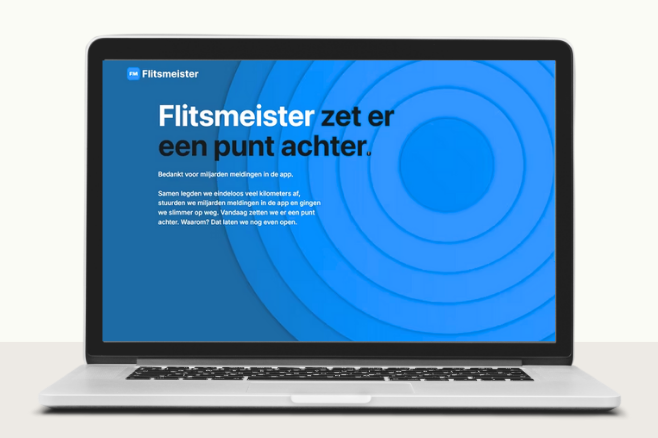
The Dutch company Flitsmeister informed its 3 million users last Wednesday that they were calling it quits. This was not only visible on the website and when opening the app, but the company actively informed its users via email, stating that they wanted to thank the billions of notifications in the app, and that they are calling it quits. It will not surprise you: this gave everyone the impression that Flitsmeister was shutting down.
But what did it turn out to be later? Flitsmeister was only stopping with the One, the separate device that displayed traffic information like speed cameras and traffic jams, similar to the app on the smartphone. This step coincides with the introduction of a new device: the DOT. This not only caused a lot of confusion among users, some were furious. A quick browse on X shows that people were so fed up that they deleted the app and switched to the competitor, Waze.
Pros & cons
Well, this commotion ultimately ensured that Flitsmeister received lots of publicity for the new product. And isn’t that the goal of a PR stunt? Yes, but not at any cost. If we dissect this PR stunt, one aspect is very strong: the newsworthiness. A PR stunt must be special, unexpected, or timely.
At the same time, credibility is crucial: the stunt must align with the identity and values of your organization. Here, Flitsmeister missed the mark. Where the company is normally praised for its reliability (on the road), this communication sowed confusion and no longer seems credible. The goal is to naturally gain editorial attention and thus indirectly activate word-of-mouth advertising, not by attempting to actively deceive.
A beautiful hit from PVS... uhh PSV
An example of how a PR stunt can remain innocent and still become a success is the 'spelling error' on the banner at the Philips Stadium. This caused both media and consumer amazement ('How can such a big club make such a stupid spelling mistake'), but people didn’t feel deceived. In fact, people shared this peculiarity en masse (especially fans of other football clubs). PSV fans hoped it would stand for Peter Verlengt Snel (PVS), the coach of the Eindhoven football club.
That this later turned out to be a PR stunt by Centraal Beheer, from the well-known 'Even Apeldoorn Bellen', fits perfectly into the picture. Their banner was subsequently hung next to it, completing the stunt. Although it might have seemed reasonably straightforward to the outside world, many months of hard work preceded this by many different people. No one was misled, and it certainly didn't yield any less media coverage. A massive hit.