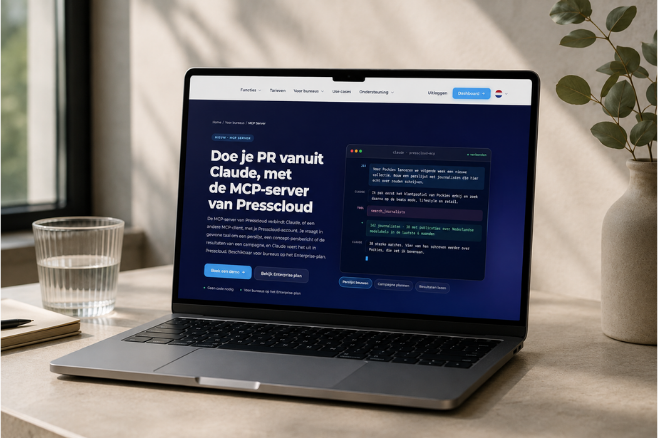
Building a press list, preparing a campaign, reviewing results, and then determining which journalists deserve follow-up. Normally, this means different screens and checks. With our new MCP server, this can now be done from one conversation.
The Presscloud MCP server connects Claude, or another MCP client, directly with your Presscloud account. You give a command in plain language and the AI then uses the appropriate functions within Presscloud. This shifts AI from just thinking along to actually collaborating.
First things first: what is MCP?
MCP stands for Model Context Protocol. Anthropic introduced this open standard at the end of 2024 to allow AI assistants to communicate with external systems, data sources, and tools in a uniform way.
For Presscloud, this means specifically: your AI client gets access to the PR tools you authorize. For example, from Claude, you can:
search for journalists within our database of 80,000+ Dutch and Belgian contacts;
build a press list per client or campaign;
generate a draft press release;
set up an embargo, dispatch timing, and target audience;
pre-check how many recipients and credits a dispatch will use;
review opens, clicks, and responses.
The AI can combine multiple actions. Thus, you don’t need to navigate back to Presscloud for every step.
Especially interesting for agencies
The MCP server currently runs on our agency accounts and is part of the Enterprise plan. This is precisely where we found a very clear application first.
An account manager with dozens or even hundreds of clients quickly encounters the same limitation: devising a separate PR campaign for each client, writing it out, assembling a press list, and preparing everything simply takes too much time.
With the MCP server, that changes. From one AI environment, agencies can prepare campaigns for multiple clients or labels simultaneously, draft press releases, compile relevant press lists, and schedule dispatches. The account manager defines the direction and checks the output, while a large part of the preparatory work is automated.
This suddenly makes PR much more scalable. Not serving five clients actively because there’s time, but potentially structurally including dozens or hundreds of clients in a PR proposition. All client accounts remain neatly separated within Presscloud, while the agency can manage multiple brands and campaigns from the same connection.
AI gets more space, you remain in control
With so much automation comes one important requirement: an AI assistant cannot independently decide to email hundreds of journalists.
Therefore, writing and sending are deliberately separated. A campaign can be prepared, checked, and scheduled, but the actual dispatch always requires your confirmation. Moreover, with the access token, you determine which rights a client gets. The connection requires no customization or developer. You create a token, add the Presscloud server to a compatible client, and you can start.
For us, this is mainly the next step in the same development we’ve been seeing: AI is not just collaborating in PR anymore, but is becoming increasingly part of the actual workflow. The human PR professional does not disappear in this process. Instead, they gain a colleague who can click remarkably fast.